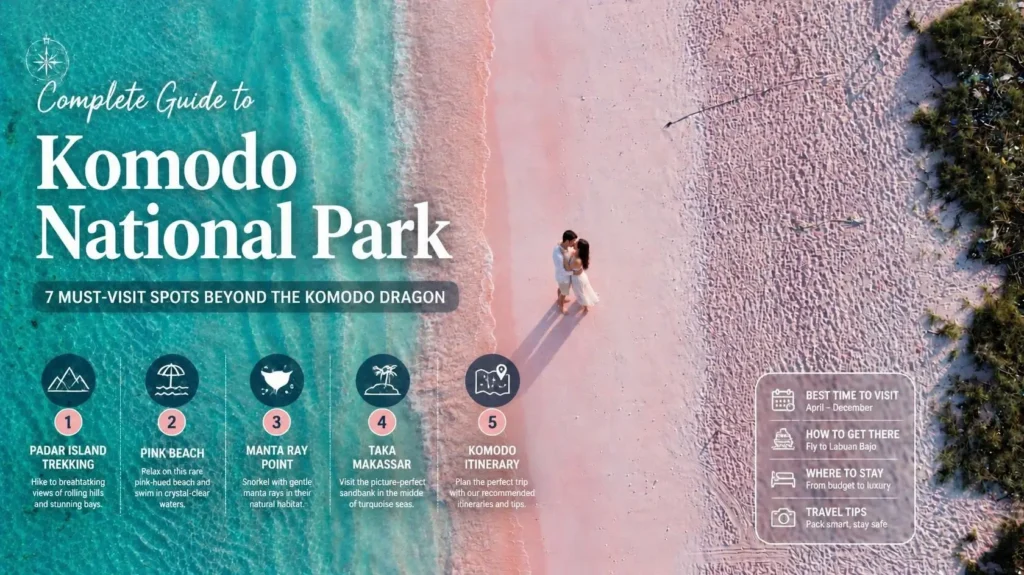
Komodo National Park: 7 Must-Visit Spots Beyond the Dragon
Most travelers arrive in Labuan Bajo with one thing on their mind: seeing the Komodo Dragon. And rightly so, it’s the only place on Earth where you can encounter these prehistoric giants in the wild. But here’s what many first-timers don’t realize: Komodo National Park is home to other seven extraordinary spots that often become the very reason people return.
From the iconic three-bay viewpoint atop Padar Island to snorkeling alongside gentle Manta Rays at Manta Point, the best experiences here extend far beyond a glimpse of the world’s largest lizard. This guide walks you through all seven spots in the order our guests typically experience them, complete with the best times to visit and practical tips you won’t find in most travel blogs.
Whether you’re planning a 1-Day trips, 3-day liveaboard or a week-long adventure, by the end of this article you’ll know exactly which spots deserve a place in your itinerary and why skipping them would be a mistake.
1. Padar Island; the Iconic Viewpoint in Komodo National Park
Padar Island is one of the reason many travelers willingly wake up at 4 or 5 AM in the morning. The trek to the summit reward you with a panorama of three bays, each with different sand color: volcanic black, pristine white, and soft pink.
What you need to know about the trekking trails in Padar Island
The trail isn’t long but the firs and half is steep and almost entirely exposed to the sun. Total hiking time is around 45 minutes to 1 hour, depending on your pace and how often you stop for rest and taking photos. The trek is moderate, you’ll be out of breath, but every step pays off.
Trekking to the summit of Padar Island feels like gently peeling back the wrapping of a precious gift. With every step and every resting point along the trail, the view slowly unveils itself from a new angle — and when you finally stand at the top, the whole island spreads out before you in all its glory, a true feast for the eyes
Best Time: Sunrise vs Sunset
Sunrise is the favorite. The morning light is softer, temperatures are cooler, and the ocean colors are stunning for photography. Sunset offers warmer tones but tends to be more crowded. As for the midday, based on the National Park Authority, Padar Island is closed with the reason is for safety beacuse the heat intensifies significantly, and there’s almost no shade along the trail. So, Padar island is open until 10.00 AM in the morning and open again from 03.00 PM in the afternoon.
Practical Tips
- Wear non-slip shoes or hiking boots. Flip-flops won't cut it.
- Bring at least one bottle of water, a hat, sunglasses, and apply sunscreen.
- Some sections are steep, so slow down on the descent.
2. Pink Beach; The Rarely Crowded Pink Sand Beach
Snorkeling at Pink Beach
Best Timeto visit
Arrive before 10 AM to avoid the crowds and catch the best light for photos. Avoid 11 AM–2 PM during peak season, when multiple tour boats anchor at the same time.
Important Note: Taking pink sand is strictly prohibited. Violations carry heavy fines.
3. Komodo Island vs Rinca Island — Where Should You See the Dragon?
Key Differences
| Aspect | Komodo Island | Rinca Island |
|---|---|---|
| Size | Largest island in the park | More compact |
| Trekking | Short, medium, and long routes (up to several hours) | Shorter, flatter routes |
| Crowds | Busier, especially July–August | Quieter |
| Dragon Sightings | High, but dragons are more dispersed | Very high, often seen near the ranger station |
| Terrain | Dry savannah and coastal hills | Savannah, mangroves, and small streams |
| Best For | Photographers, deeper trekking | Families, limited itineraries |
Practical Recommendation
If your time is limited or you’re traveling with children: choose Rinca. If you want a more thorough trekking experience and don’t mind sharing the trail with more visitors: choose Komodo Island. Many operators include both in their itineraries since they’re close to each other.
Ranger Tips and Safety: Always follow the ranger’s instructions. Never approach without permission. Komodo Dragons are wild animals, not exhibits.
4. Taka Makassar; The Sandbar That Appears at Low Tide
Taka Makassar isn’t technically an island. It’s a crescent-shaped sandbar that only appears at low tide. When the tide comes in, it disappears under waist-deep water, leaving behind a calm, crystal-clear lagoon.
What to Do Here
Landscape and drone photography are hugely popular here. The contrast between the slightly pink white sand, shallow turquoise water, and deep blue ocean in the distance creates a stunning visual. The water is calm and shallow—ideal for swimming or light snorkeling, even for children.
Practical Notes
5. Manta Point; Snorkeling with Manta Rays
Best Season and Currents
The dry season (April – October) offers the best visibility. However, be aware: currents at Manta Point can be strong, making this spot better suited for experienced snorkelers or at least those comfortable in the water.
Tips for Beginners
Use fins for maneuvering. Don’t chase the mantas, let them come to you. Sightings depend on natural conditions; there’s no 100% guarantee.
6. Turtle Point at Siaba Island — Where Turtles Outnumber Tourists
Why Siaba Island Stands Out
Unlike the dramatic coral walls of Manta Point, Siaba offers a gentler, more relaxed snorkeling experience. The water is shallow, often only 2–5 meters dee and the currents are mild. This makes it perfect for beginners, families, and anyone who wants to float peacefully while watching turtles graze on seagrass.
Best Time to Visit
Practical Tips
- Keep a respectful distance from the turtles—at least 3 meters.
- Avoid touching or chasing them. They're protected species.
- Bring an underwater camera; the visibility here is excellent for close-up shots.
7. Gili Lawa — The Sunset Trek with Panoramic Views
The Gili Lawa Trek
The hike takes about 30 – 45 minutes and is less steep than Padar. It’s ideal for those who want a stunning viewpoint without the early-morning crowd or the strenuous climb. The reward at the top: sweeping views of Gili Lawa Darat and Gili Lawa Laut, with boats anchored in the bay below.
Best Time to Visit
Practical Tips
- Bring a light jacket—it can get windy at the top.
- Wear sturdy sandals or shoes; the trail is rocky in parts.
- Don't forget your camera. This is one of the most photogenic spots in the park.
Frequently asked question
Is Padar Island trekking difficult?
Can you snorkel at Pink Beach without a guide?
No, cause currents can change. A tour guide knows well about the current condition inn the area and guide you for your safety. Always follow the tour guide and boat crew’s instructions. they are known this places very well.
Are there always mantas at Manta Point?
Not 100%, but try to visit from April to June or September to November for a very high chances.
Is Siaba Island good for beginners?
Yes, the water is shallow, currents are mild, and turtles are easy to spot. It’s one of the most beginner-friendly snorkeling spots in Komodo.
How many days do you need to explore Komodo?
At least 3 days and 2 nights trip for an unhurried experience.